

SAMO Financial
Search
  • Home
  • Our Services
    • Public Speaking
    • Our Products
    • Testimonials
  • About Us
    • Media
  • Blog
    • Video Lessons
  • Join The SAMO Club
  • Library
  • Contact
    • FAQ
  • Home
  • Our Services
    • Public Speaking
    • Our Products
    • Testimonials
  • About Us
    • Media
  • Blog
    • Video Lessons
  • Join The SAMO Club
  • Library
  • Contact
    • FAQ
Alina Trigub2021-08-01T19:22:32+00:00

Are compound and cumulative dividends the same thing?

Every investor loves the word “dividend.”  Stocks in general and especially the so-called “dividends kings” stocks often pay dividends making that stock more attractive. Commercial real estate investments are furthermore attractive when dividend payout is offered towards the investor’s benefit. There are two basic dividend payouts, and investors may not fully understand the nuances of dividend types, and therefore I wanted to explain it.

Dividends that are paid out to investors can be either cumulative or compound or both.

First, let’s list the terms associated with dividend distribution, and then we will move on to flesh out these terms with actual examples, which will will help you make a more informed decision when reviewing the next investment offering. Normally, returns from dividends are calculated as a percentage of the original investment.


Dividends can be either Cumulative and Non-Compounding or Cumulative and Compounding (or just Compounding).


Here is where an investor may unknowingly use these terms interchangeably, and will therefore miss out on the full benefit of their differences, and there may indeed be a big dollar difference. So later in this article we will go over a couple of dividend calculations to help you hold your own during contractual discussions.


Cumulative in this sense means that the dividend is just based on the original per-share price, while Cumulative and Compounding means that the dividend is not only based on the original per-share price, but also includes the amount that accrues over time.


This difference is shown in the table and the figures below.
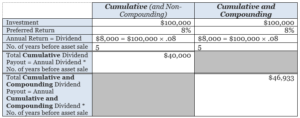


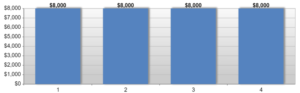
As you can see in the table above and in the bar graph below, a simple Cumulative Dividend will have earned the investor $8,000 annually, and the total dividend payout after 5 years will be $40,000.


However, using the same original investment and dividend percentage, but instead calculating Cumulative and Compounding Dividend calculation, the 8% annual dividend will have earned the investor $46,933 in dividends.
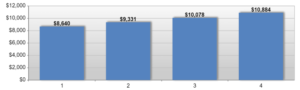


Obviously, there is a sizeable difference between Cumulative and Compounding Dividend. However, even more importantly you learned something new that will ensure  your understanding of an investment offering you are reviewing in the future.


Have you thought about passively building your wealth via real estate investing?

Let’s talk



Related Posts

You cannot force it to rain, but you can force a property to appreciate

You cannot force it to rain, but you can force a property to appreciate One of the ways real estate allows... read more

What is mineral rights investing

What is mineral rights investing Out of all investment strategies in real estate, whether it's single family housing, multifamily, warehouses, etc.,... read more

The 7 Mistakes High Earners Make Before Investing in Real Estate

The 7 Mistakes High Earners Make Before Investing in Real Estate A high income can create a false sense of financial... read more

Interview with a passive investor

Interview with a passive investor You know how the operator always speaks from their perspective. I wanted to share with my... read more

Interview with a passive investor

How to be a successful part-time investor Alina Hello and welcome everyone to this 2022 edition of the  SAMO Financial interviews. Today... read more

We are all brainwashed to hold on to old beliefs

We are all brainwashed to hold on to old beliefs For many generations, women have been seen as merely a child-producing... read more

Private Equity meets Stock Market

Private Equity meets Stock Market In this article, I will explore options for wealth-building, as well as how to best maximize... read more

What the changes to Biden’s Tax proposal mean for real estate investors

Biden’s Tax proposal While the drama over the next presidency plays out, some of you who invest in real estate are... read more

If I were a rich man…

If I were a rich man... If you had all the money in the world, would you invest it in real... read more

Is Your Portfolio at Risk if the Market Crashes?

Is Your Portfolio at Risk if the Market Crashes? If the title of this article grabbed your attention, you’re likely not... read more

Category

  • commercial real estate
  • Funds investing
  • Hospitality
  • Hotel conversion
  • Hotel conversion into multifamily
  • Hotel investing
  • Investing in Apartment Buildings
  • investment property
  • MHP
  • Mobile Home Parks
  • Mutlifamily
    • apartment buildings
  • Partnerships
    • Private Equity
  • passive income real estate investment vehicle
    • REIT
  • Passive Investing
    • active versus passive real estate investing
    • best passive real estate investments
    • definition of passive real estate investment
    • passive commercial real estate investing
    • real estate investing passive income
  • passive investing in real estate
  • passive real estate investment advantages
  • passive real estate investment disadvantages
  • Passive VS Active real estate investing
  • Real Estate
    • property management
  • SDIRA
  • self-storage
  • Syndications
    • real estate syndication
    • syndication model
  • tax strategies for real estate investors
  • Triple Net Lease

Tags

alternatives apartment building investing apartment complex Assisted Living blind pool building wealth checkbook control Choosing the right team Coronavirus COVID-19 dividends fund of funds investing investing via syndications IRA LLC limited partnership Main Street investing MHP Investing multifamily multifamily investing multifamily investment net lease NNN lease pandemic passive income passive investment passive real estate investing private lending real estate investing REIT vs PE Residential Assisted Living SDIRA self-rental rules self-storage investing Senior Living STNL syndications syndications terminology tax advantages tax savings Value-Add virus Wall Street wealth building wealth preservation
SAMO Financial © Copyright 2026. All Rights Reserved.