

What is a better investment: private equity real estate syndication or REIT?
Folks from all walks of life want to improve their families’ financial standing through investing. However, there are so many investment vehicles available to investors that it is not uncommon to confuse similarly sounding investments, as well as the risks and benefits that they offer. I unpack two such investment type, as well as the differences between them – Private Equity (PE) real estate syndication versus Real Estate Investment Trust (REIT).
Private Equity Real Estate Syndication Investing
Private Equity Syndication investing, unlike stock trading takes place outside of Wall Street.
Just as the name implies, it typically entails individuals or private groups to fund a project, such as buying a business or an asset, or in a slightly more complex example, setting up a private fund that either buys or invests in businesses or properties. Investors are partners in the LLC that owns the physical property, not just shares as in a stock market purchase.
Private Equity investments are managed by specialized firms that introduce various projects or funds to investors, whether they are individuals or companies. Private Equity firms require their investors to be accredited, which has a very specific connotation. The definition of Accredited Investor became more wide-ranging, as it now includes individuals that have not met either income or net worth requirement, rather qualify through various financial certifications.
While Private Equity firms pull money together from individuals or companies to buy, develop and operate real estate, the securities are not publicly traded.
Since PE firms are not bound by REIT-related regulations, it allows them to invest in a much wider variety of real estate. This differentiator also allows to put a legal structure together that will differentiate it from REIT, which entails not being required to pay a high percentage of income in dividends. In fact, Private Equity firms typically pay out their distributions in the form of capital gains and carried interest. This structure allows investors to reduce their taxable income through depreciation, as well as through capital gains that are taxed at a maximum of 20%, as opposed to REIT structure, based on dividend payments taxed as ordinary income rate that can be as high as 37%. PE firms clearly spell out their fee structure in legal documents, and it is closely correlated to performance of a project or a fund.
If your goal is liquidity for your investments, Private Equity will not suit you. However, if you wish to diversify into tax-friendly long-term investments, you should consider Private Equity investing. Before investing in Private Equity you need to be very honest with yourself about your investment goals because you need to find a firm whose strategy and interests match yours. For instance, if you are looking for long-term appreciation, find a firm that either concentrates on a long-term investing strategy or offers a fund with this type of strategy. Needless to say, you have to conduct your own research and due diligence to determine whether this firm has investing experience and industry reputation.
Real Estate Investment Trust Investing
REIT on the other hand allows investors to invest in a large-scale portfolio of real estate properties; therefore REIT is similar to a mutual fund with a concentration on real estate. Investors can purchase and sell shares of REIT at any time. REITs typically do not develop properties – their common objective is to buy real estate into their portfolio and operate it for profit.
There are three types of REITs:
- Publicly-traded REIT, which as the name suggests is accessible for investment via the stock market.
- Non-publicly-traded REIT, which is not offered via stock exchanges, but it has to be registered with Securities and Exchange Commission (SEC). This type of REIT tends to be more stable and independent of market fluctuations than publicly-traded REITs.
- Private REIT, which is typically offered to institutional investors. Private REITs are not listed on national securities exchanges, nor do they have to be registered with SEC.
To qualify as a REIT, the firms must meet IRS-established requirements such as:
- 90% of taxable income must be paid back to shareholders on a regular basis. This is a tax advantage for a fund, but not for the investors
- 75% of gross income must be acquired from real estate-related origins
- 95% of gross income must be passive
- Be an entity that is taxable as a corporation
- Be managed by a board of directors or trustees
- Have a minimum of 100 shareholders
- Have no more than 50% of shares held by five or fewer individuals
REITs benefits include an investment liquidly and diversification. REITs are also overseen by independent directors or auditors. Their performance is typically slightly above of their mutual funds’ counterparts. While these benefits are attractive, there are also downsides. Firstly, REITs can be constrained in growth due to the fact that they’re required to pay at least 90% of their taxable income as dividends. REIT investors are typically taxed in a higher tax bracket, since as I mentioned earlier, their dividends will be taxed as ordinary income, which will be as high as 37%. Another drawback is that publicly traded REIT price movements can be subject to the whims of public markets, which don’t always reflect the fundamentals of the underlying assets. Finally, REITs often have a high front-end “load” fees, meaning that they require 5% – 10% of the initial investment in the form of fees.
The table below summarizes some of the major differences between REITs and private equity real estate syndication.
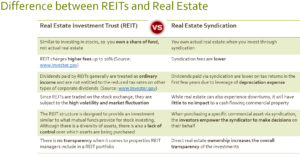
Which is a better investment you may ask? The answer is, that it depends on your goals and other factors, such as the investor’s time horizon, risk tolerance, liquidity preference, net worth, and investment strategy.
The key is finding the right fit for each investor’s individual situation.
So, when attempting to choose between a REIT and a Private Equity real estate firm, the question shouldn’t be, which is better, it should be which option is more suitable for the investor’s unique situation.
Have you thought about passively building your wealth via real estate investing?
Let’s talk