
What goes up must eventually come down (or Real Estate Market Cycles)
We’ve all heard the old cliché, “What goes up, must come down.” Well, this proverb also certainly applies to the real estate market. As long as we are citing clichés, here’s another that we should all take to heed, “Measure thrice, check twice, and cut once.” What I mean by this is that investors need to do their due diligence analysis when evaluating the market, the geographic location, and the property in which to invest. Otherwise the investor stands to increase the risk of a significant negative implication on the overall asset lifetime (how long to hold on to the asset), and how it will react to the market fluctuations. In other words, investors need to pay close attention to the signs of market fluctuation in order to determine the phase of each particular market. One of the more common mistakes that I see some novice investors make is to generically apply the phase of a market in a particular geographic area to the state of the market in a completely different location.
Your goal as an investor is to buy the best-valued asset at the correct location at the precise time. Ideally you want to avoid buying assets in depreciating markets, and instead spend more time researching assets in appreciating areas.
Here’re are case studies of four Market Cycles; two representing appreciating markets, and two epitomizing declining markets. But first, let’s identify terminology:
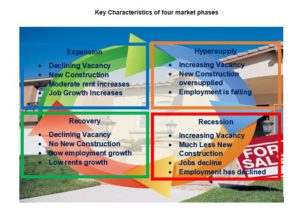
The two appreciating market cycles are known as Recovery and Expansion, and conversely, Hypersupply and Recession are the two declining market cycles. The primary features of the market cycles include:
- vacancy rates,
- new construction,
- employment growth, and
- rental rate growth.
Let’s take a closer look at all four market cycles and how the assets’ primary features change with the market cycle.
Recovery Market Cycle
Although somewhat counterintuitive, the beginning of a Recovery market cycle is identified by most people as the “bottoming of the market.” At this moment the market stops freefalling, and either slowly levels off or even shows some signs of growth. During a Recovery, vacancy rates begin to stabilize and actually somewhat decrease.
Any guesses why the vacancy rates drop? Well, one of the main reasons is due to very low or virtually no new construction after the market recovers from a downturn. During most Recoveries there is very little new supply coming on the market, and therefore current property occupancy rates stabilize. Likewise, there is usually low employment growth, but the positive aspect is that the decrease in jobs has ended. During a recovery you will see very low rental rate growth and rent prices may even dip a little. Again, the positive characteristic about this phase of the market is that it signals the end of a declining market.
Your takeaway should be that this is a great time to buy properties for cash flow, and when the market really improves, you will see major jumps in rental rates, occupancy, and value.
Expansion Market Cycle
The following market cycle is Expansion. Expansion is a very stimulating market phase since at this point the economy begins to pick up again. During Expansion the vacancy rates start decreasing, even while a bit of new construction pops up at first and a great deal more toward the end of the cycle. Absorption rates pick up as more people go back to work or upgrade jobs. Similarly, job growth as well as personal income pick up pace, which in turn leads to moderate to high growth rates in rents. Property values continue to increase until the end of the Expansion Market Cycle, where they hit their peak.
Your goal is to invest at the beginning or middle of this cycle, and put your asset on the market to try timing to sell it towards the peak; before the market starts declining again. Property values hit their peak at the end of this cycle and then will start to go down again. Investors who sold during the peak years made a killing, while those who bought at the peak and overpaid, will need years for their properties to be profitable again.
Hypersupply Market Cycle
Hypersupply is the market cycle that immediately follows Expansion. It happens when the market is oversupplied during the Expansion Market Cycle, while job growth slows down. As you probably already predicted, this is due to basic economics where supply, in this case new construction, now outweighs demand. Some of the results are expected; vacancy rates are on the rise again, some new construction may happen, but it is barely absorbed. Employment also starts to slow down as companies have followed through with their own major expansions. Rental rates may have stopped growing or if they are still growing, definitely at a lower rate.
It’s best to avoid buying during Hypersupply unless you buy for major cash flow that can withstand decreasing prices, and weathering the financial storm that follows next. In fact, your goal is to attempt to cut your possible losses, and sell marginal properties before the market starts to decline more rapidly.
Recession Market Cycle
Recession is the fourth stage of the real estate market cycle. As you would expect, some of the key characteristics of a Recession are vacancy rates increase as jobs and income decline, new construction brakes to a halt and fewer existing apartments or houses are absorbed. You’ll also see low-to-negative growth in employment as salaries level off and some companies even have layoffs. The bitter outcome is that the economy slows down and you’ll start to see many more rental specials offered including lower rental rates, as there are fewer people willing to pay as much for units.
During a Recession it is essential to focus on buying quality properties that provide strong cash flow. While your value will probably not increase anytime soon, you can still find properties that will provide a strong cash flow down the road.
The below table depicts the main identifiers of the Real Estate Market Phases.